
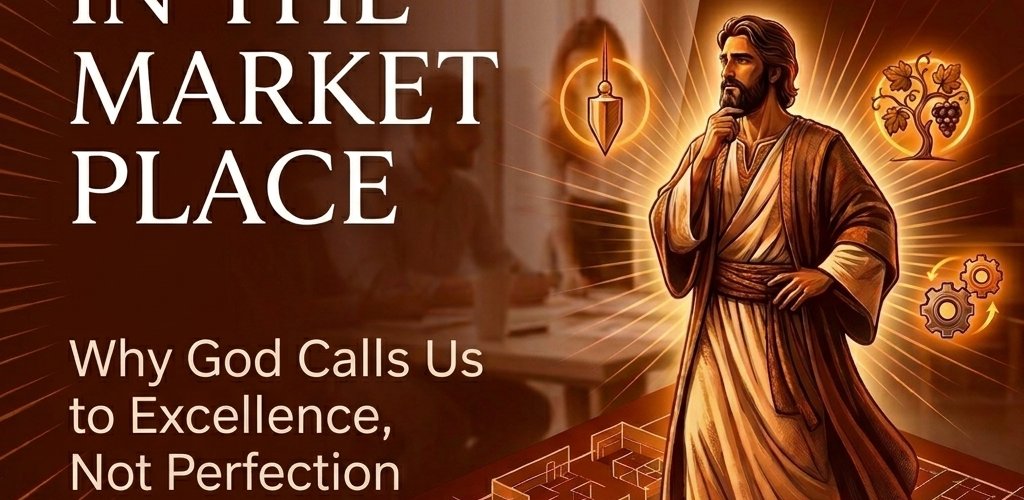
There is a quiet pressure many of us carry into the marketplace: the need to prove ourselves, to get everything right, to never be found lacking. It often masquerades as ambition or high standards, but if we are honest, it is rooted in something deeper: the fear of failure and the desire for approval. We call it striving for excellence, yet what we are often pursuing is perfection.
And the two are not the same.
Perfection demands flawlessness. It is rigid, unforgiving, and deeply tied to outcome. It leaves no room for growth, no space for process, and no grace for humanity. Excellence, on the other hand, is different. Excellence is not about getting everything right, it is about giving your best with what you have, consistently, faithfully, and with the right heart.
Scripture anchors this distinction clearly. In Colossians 3:23, we are reminded:
Whatever you do, work at it with all your heart, as working for the Lord, not for human masters.”
The emphasis is not on perfection of results, but on posture, on wholeheartedness. Excellence is a matter of devotion, not just delivery.
Perfection often traps people in cycles of hesitation. You overthink decisions, delay action, and become overly critical of your own work. It quietly erodes confidence and replaces it with anxiety. Ironically, in trying to avoid failure, perfection keeps many people from stepping into the very opportunities that would grow them.
Excellence produces the opposite effect. It invites movement. It allows for learning. It builds resilience. Where perfection says, “wait until it is flawless,” excellence says, “start, refine, and keep going.”
When we look at biblical models, this pattern becomes even clearer. Daniel is described in Daniel 6:3 as a man who distinguished himself because of an “excellent spirit.” Not a perfect one, an excellent one. His consistency, discipline, and integrity set him apart in environments that were not always favourable or aligned with his beliefs. His excellence was not dependent on circumstance; it was internal.
The same can be said of Joseph. Whether in the pit, the prison, or the palace, Joseph operated with a level of diligence and stewardship that made him trustworthy. He did not wait for ideal conditions to perform well. He understood that excellence is not situational, it is a standard you carry within you.
In the modern marketplace, excellence takes on very practical forms. It is seen in ownership, the willingness to take responsibility beyond what is required. It shows up in consistency, doing the work well, not just when it is visible, but especially when it is not. It is reflected in integrity, where your private standards match your public output. And it is sustained through a posture of growth, where you remain teachable and open to refinement.
Proverbs 22:29 reinforces this truth:
Do you see someone skilled in their work? They will serve before kings.”
Skill is not accidental. It is cultivated. Excellence requires intentionality, it is built over time through discipline and commitment.
The challenge, however, is how to pursue excellence without slipping back into perfectionism. The shift begins with redefining success. Success is no longer about flawless execution, but about faithfulness and growth. It means taking action even when you do not feel fully ready, trusting that clarity and competence will develop along the way.
It also requires building systems rather than relying on pressure. Excellence is sustained by habits—how you prepare, how you follow through, how you review and improve. It is not driven by occasional bursts of intensity, but by steady, disciplined effort.
Perhaps most importantly, it demands that you anchor your identity correctly. When your sense of worth is tied to your performance, perfectionism will always creep in. But when your identity is secure, you are free to pursue excellence without fear, free to take risks, to learn, and to grow.
As Ecclesiastes 9:10 puts it:
Whatever your hand finds to do, do it with all your might.
Not perfectly, but fully. Not fearfully, but faithfully.
At its core, excellence is an act of worship. It is how you honour God in the marketplace, not by being flawless, but by being faithful. It is seen in how you steward your responsibilities, how you treat people, and how you show up even when no one is watching.
Perfection will exhaust you. It will keep you striving, comparing, and constantly feeling behind.
Excellence will ground you. It will grow you. And ultimately, it will position you, not just for success, but for impact.
By Pressy Kaburu




Add comment