
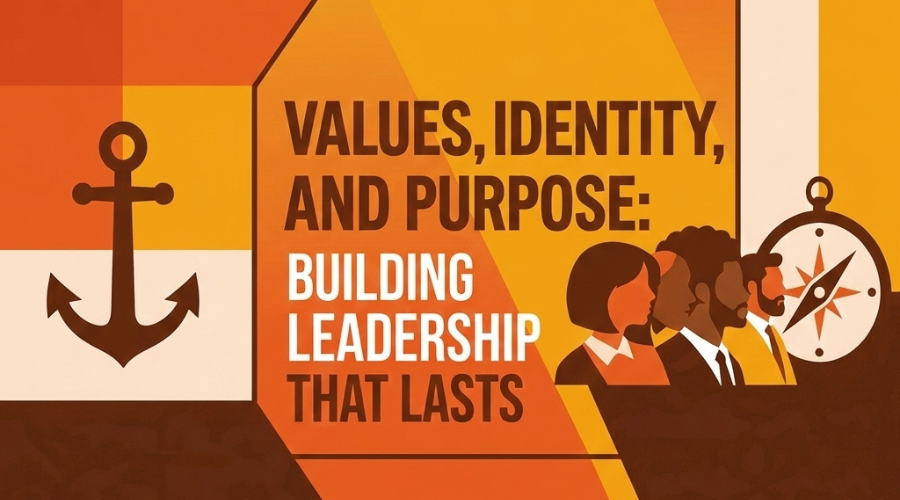
There is a quiet assumption in the marketplace today that if we can define an organization’s purpose clearly enough, articulate its values strongly enough, and position its brand convincingly enough, then success will follow.
But this assumption misses something fundamental.
Organizations do not become clear because their statements are clear. They become clear because the people leading them are.
At its core, leadership is not first an external exercise. It is an internal formation. And the language of values, identity, and purpose so often used at an organizational level must first be grounded at a personal one.
Because what is not formed within will eventually fracture without.
Identity is where this journey begins. In a world that rewards performance and visibility, it is easy to build identity around what we do, what we have achieved, and how we are perceived. Titles become anchors. Access becomes validation. Success becomes a mirror through which we understand ourselves.
But these are fragile foundations. The moment circumstances shift and they always do, identity built on external markers begins to shake.
Scripture offers a different anchor. It speaks of identity not as something we construct, but something we receive. “You are a chosen people, a royal priesthood, a holy nation, God’s special possession.” This is not language of striving, but of establishment. It calls the believer to lead not in pursuit of worth, but from a place of already being known, chosen, and positioned.
When identity is settled in this way, leadership changes. There is less striving to prove and more conviction in action. There is less comparison and more clarity. Decisions are no longer driven by insecurity, but by alignment.
From identity flows values. Yet values, as they are often presented, can be misleading. They are written, displayed, and spoken about, but rarely tested in the environments that matter most. Real values are not aspirational statements. They are the principles that hold when there is pressure, when there is cost, when compromise would be easier.
“A tree is recognized by its fruit,” Scripture reminds us. Values are that fruit. They reveal what is truly rooted within a person or an organization.
Where identity is unclear, values become flexible. They bend under pressure. They adjust to convenience. But where identity is anchored, values become consistent. They are lived, not performed. And over time, they build something far more powerful than perception they build trust.
Purpose then emerges, not as something to chase, but as something to align with. In many spaces, purpose is framed as ambition, something to discover, define, and pursue. But purpose, in its truest sense, is not self-generated. It is revealed through alignment between who you are, what you carry, and where you are called to serve.
“We are God’s workmanship, created in Christ Jesus to do good works, which God prepared in advance for us to do.” Purpose, then, is not a product of effort alone. It is a response to design.
This reframes the pressure many leaders carry. The question shifts from “What should I build?” to “What have I been entrusted to steward?” From striving for significance to walking in alignment.
And this is where the connection between personal formation and organizational health becomes undeniable.
When leaders are internally misaligned, organizations reflect it. Culture becomes inconsistent. Values become slogans. Purpose becomes diluted. Over time, the gap between what is said and what is lived begins to widen, and trust erodes.
But when leaders do the work of becoming, when identity is settled, values are embodied, and purpose is aligned, organizations take on a different nature. They become coherent. Decisions carry weight. Culture becomes intentional rather than accidental.
The marketplace does not simply need more visible leaders. It needs more grounded ones.
This kind of leadership is not built in moments of visibility, but in seasons of quiet discipline. It is formed in the daily decision to anchor identity beyond performance, to uphold values when it is inconvenient, and to pursue purpose as an act of obedience rather than ego.
Transformation, as Scripture reminds us, comes through the renewing of the mind. It is internal, often unseen, but it is the very thing that sustains everything that is visible.
Values, identity, and purpose are not tools for branding. They are tools for formation.
And the leaders who take this seriously will not only build organizations that succeed—they will build ones that endure.
By Pressy Kaburu




Add comment